

 This drew me suddenly back to my student days, for almost exactly the same scene had been documented by me in 1977. Since I keep the pictures in my slide trays in fond memory, I could conclude that the building was essentially unchanged, with one interesting exception: the bank’s logotype had been changed from being rather serene to being gaudy, by having a two colour symbol added to it. This was, no doubt, a sign of the times. The venerable institution is no more, we look upon the sad remains of boundless ambition, thwarted by cleansing within the recent crisis.
Before travelling to Berkeley for the first time, back in 1976, I wrote a letter to the bank’s Telegraph at Russell office, asking to open an account. I received a cordial reply to the positive in return, as well as all kind of helpful support upon our arrival and throughout our stay. In sentimental gratitude, I had kept my savings book during all the years since then, in case I would return some day and again would need to transfer some money prior to my voyage. Last December, I wrote a letter to this effect to the now Shattuck office. To my regret, and even after a second letter as reminder, no answer was received from the bank so, with sadness, I took my business elsewhere.
 From the bank it is only a ten minutes’ walk to the Campus entrance, which soon was reached. When approaching Sather Gate, it emerged that yet another campus event was in the making. It was still early morning (in campus terms!), with not many people around, but stands were already being built up and flags unfurled. I approached a nice looking young student in traditional garbs and started to inquire about the event. She answered me first in French, as if by reflex, but soon caught herself at it and continued into English. Not to be bested I of course switched the other way and we had a long and cosy chat in the language of Racine. It turned out that she came from Vietnam and had studied first in Paris and now here in Berkeley, her subject being education. Generous grants from both France and the US had made this possible. It was heartening to see, how the former adversaries pay host to young Vietnamese and how the youngsters are able to surmount ancient hatreds and thrive in former enemy countries. But I see that I am deviating from the tale’s main thread. What event was being prepared on campus grounds? It was for the first time ever that the university and its students organised an “Open Campus Week”, where the general public could visit the campus and its buildings, and partake in numerous activities provided by the various student associations. Seems to me a suitable topic for a future blog posting ;-)
My spirits having lifted after the nice encounter with the Vietnamese student, some extra exercise seemed in order, and what better way to exercise than mounting the “Campanile”, the campus’ prominent clock tower, already exhibited in an earlier posting (“I have arrived”). Unfortunately, you cannot climb the stairs, so I was forced to take the elevator. The view from the top is marvellous, you see a major part of the Bay from there, provided favorable weather conditions. I shot a photo of Telegraph Avenue, more or less straight to the South, thinking of Peter, who had, in a comment to this blog, suggested that it be visited and documented. What you are seeing in the picture, Peter, is not Telegraph as you recall it; that part of the street is, unfortunately, hidden between the tall buildings on the lower right. Instead, the picture shows the street where it, after a sharp bend, broadens into an avenue that goes on for many miles into and through Oakland, the big city south of Berkeley.

A main item of interest on the picture is, however, the surprising amount of greenery, dominating the view and reaching almost to the high rises in downtown Oakland. Somehow resembling Brussels, it is caused by the pre-eminence of single homes along shaded avenues, each with its larger garden hidden from the street, which makes life so agreeable in these well-off parts of the Bay cities. The view does not show, and I would hesitate to document, the poorer residency regions, located in West Oakland and Berkeley, where industries thrive and housing is generally debilitated and burnished by un-shadowed sun. You wonder where Stuart Street might be located? Trace with your finger along Telegraph, until you see the first large building on the right hand side, about two third into the picture. Just one block before it, Stuart starts off towards the right. You can, of course, only see trees from the tower. The street is completely lost in the greenery.
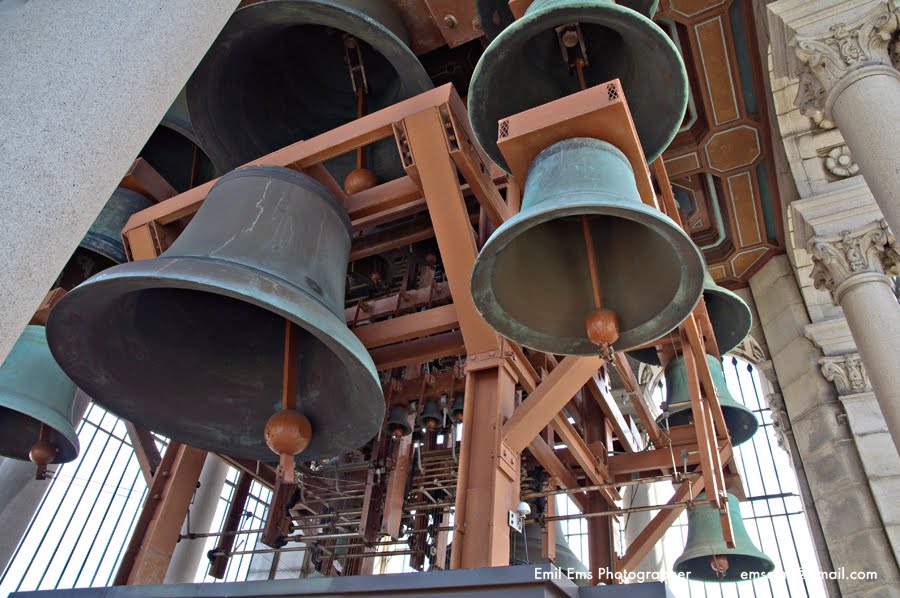
Reluctantly withdrawing our glances from this beautiful vista and turning them upwards, we notice another one of the campus’ landmarks. More than 60 bells are tingling above your head. I am told that this is world record for a bell tower. For a future blog we will have to go back up there at noon to witness the carillon master at play. You didn’t know what “carillon” means? Don’t worry, me neither, not until having read a brochure about the Campanile. It means nothing else but “Glockenspiel”, the music being played by bells.
Underneath the Campanile lies a beautiful plaza with shaded benches, providing, due to its elevation, a wonderful vista of some of the campus’ most venerable buildings. Neither shade nor views appeared however to be of interest to a young student deeply involved, I hope, in learned manuscripts. It never ceases to surprise us seniors that youngsters, in particular girls, can manage to read books in the full glare of the sun, sometimes for hours, whilst maintaining a position that is hurting our knees just looking at it. This view, to be enjoyed all over UCB is, in my opinion, to be counted among the impressive landmarks on campus.

What would the girl have seen, if deigning to lift her eyes from the glaring pages and gather the surroundings for a spell? No other than the oldest building on campus, South Hall, built in the 1870’s (originally together with North Hall, which is long gone), shining in the morning sun with its prominent dark brown bricks and fanciful architecture. The university was founded just after the civil war period as an institute of high learning in the fields of agriculture mechanical arts and military tactics. Its first station was in Oakland. It was moved to Berkeley first in the early ‘seventies. If you look closely at the ornaments of South Hall (topic for another blog posting, I can assure you) you soon realize that they all represent species of edible plant, a reminder in bricks and mortar of the early beginnings.

Time to continue on our pilgrimage! After a brisk northward walk through the remaining part of the campus I eventually arrived at the North Gate, located more or less opposite Sather Gate on the south side. This was a first for me. Never, in my one year and a half at Berkeley had I ventured that far north on campus! This not only bears witness to the inherent laziness of youth, engaged in other, more demanding business than strolling through campus; it also shows that the UCB campus is of substantial size, maybe twice the size of the University of Stockholm campus and more interesting, in terms of architecture and landscaped parks, than the latter. In fact, it is considered to be one of the foremost landmarks in the Bay Area, whereas I could probably count on one hand people being as interested in the Stockholm campus. If one of them is reading this posting, please speak out! Let us discuss the various views on this and that.

Continuing on a northern trajectory, you wind up, crossing Hearst Avenue, at a lovely and inviting avenue called Euclid, after the great Greek mathematician; for those who have suppressed their schoolbook memories, suffice it to mention the squaring of a triangle’s sides to freshen up your knowledge base. The entrance to the street looked enticing indeed, with youthfully green sycamores spending welcome shade, palm trees throning on top of it all and shops galore to provide refreshments to a wary hiker. The choice was rashly made to continue the journey along this route, and to deviate in the direction for Spruce Street, supposed to lie in parallel to the left, first several blocks farther along Euclid.

Eventually, the avenue bordered on a hilly neighbourhood to the left and I thought it time for tracing my steps towards my final goal. As a sign and encouragement a vigorous jogger, not altogether young, crossed the street to proceed in the appropriate direction. However, it proved rather difficult to find the right way, since I was soon lost in a manifold of small crooked ways along several hills, that were pretty unfamiliar to me and, furthermore, completely unexpected, used as I was to the perfect checkerboard of streets and avenues to be found elsewhere in Berkeley. Would I ever find the right direction to Spruce Street in all this? To keep you in suspense, let me stop here and come back to you with the answer in a forthcoming sequel.


